
Marketing Strategy Frameworks: 15 Models in One PowerPoint
4,00 $
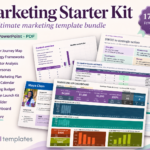
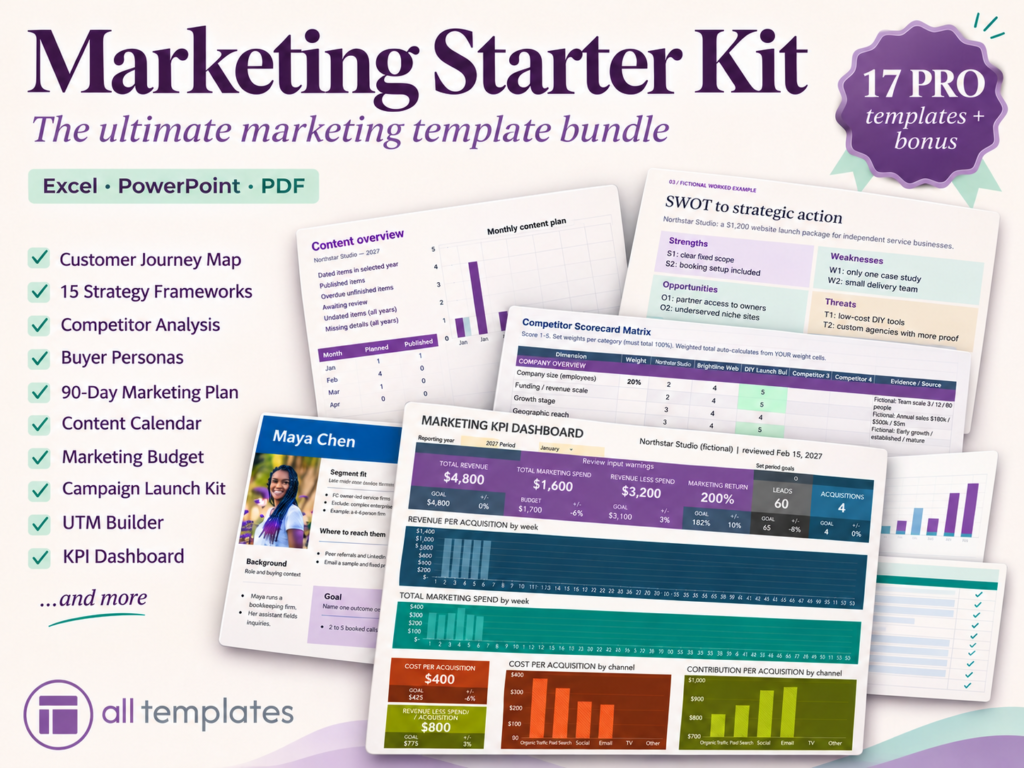
15 essential marketing frameworks in one editable PowerPoint. Pro includes 36 slides with worked examples, workshop canvases and a one-page strategy summary. Try the 17-slide Free edition or get all 15 models for $4 once.
- AI-friendly. Give a file-capable AI agent a copy and your source material. Ask it to fill the labeled inputs and check the result before using it.
Free downloads vary by product. See the description below for exactly what is included, or get the complete Pro version.
Get the complete, ready-to-use version with all features — for the price of a cup of coffee
15 essential marketing frameworks in one editable PowerPoint
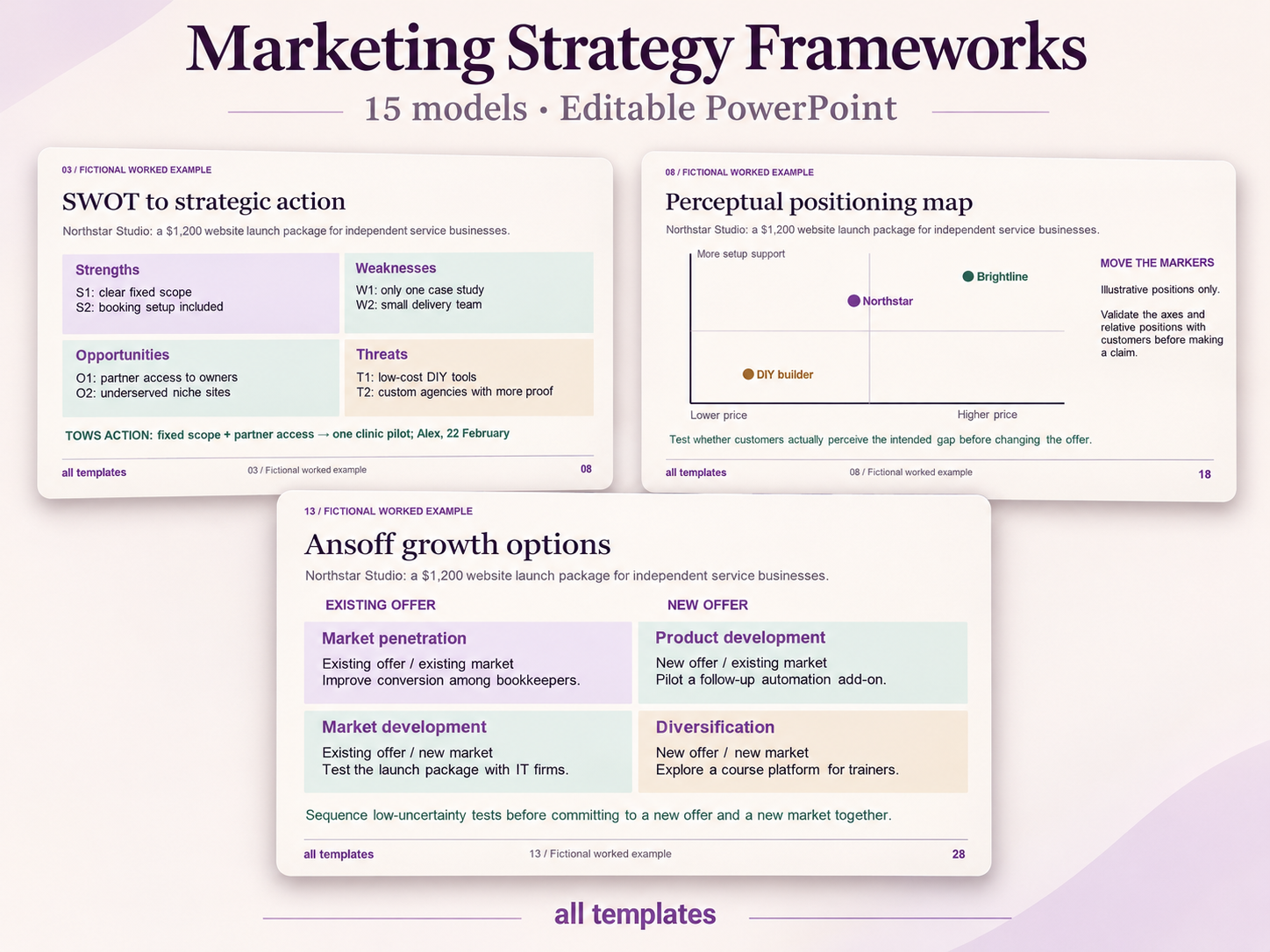
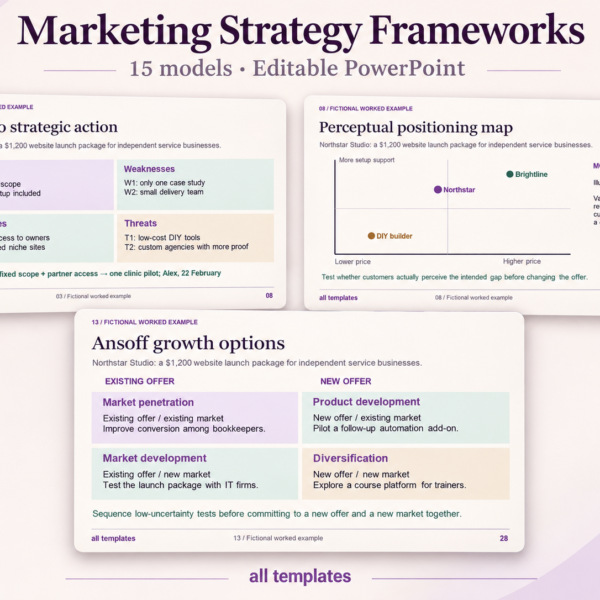
Go from a blank slide to a clear marketing strategy. This toolkit brings 15 established frameworks into one practical document, with a fictional Northstar Studio worked example and an editable workshop canvas for every model.
Use it to understand your market, choose the right customers, clarify your positioning and turn decisions into an action plan. Edit the text, tables, shapes and map markers directly in Microsoft PowerPoint.
All 15 frameworks included in Pro
- 5C situation analysis: customers, company, collaborators, competitors and context.
- PESTEL environment scan: political, economic, social, technological, environmental and legal factors.
- SWOT and TOWS action: turn strengths, weaknesses, opportunities and threats into a concrete next step.
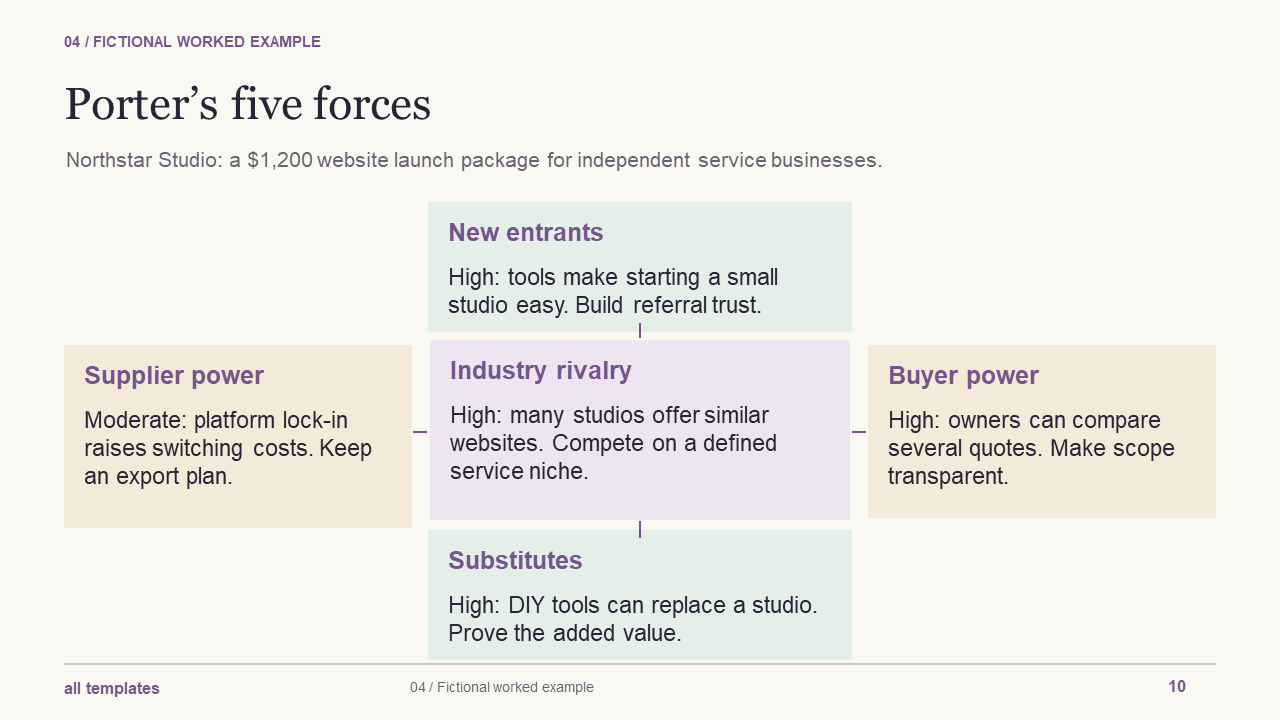
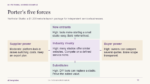
- Porter’s Five Forces: rivalry, entrants, suppliers, buyers and substitutes.
- Market segmentation: distinguish groups by needs, triggers and buying behaviour.
- Target market selection: compare urgency, ability to pay, reachability and delivery fit.
- Positioning — points of parity and difference: define your audience, category and distinctive benefit.
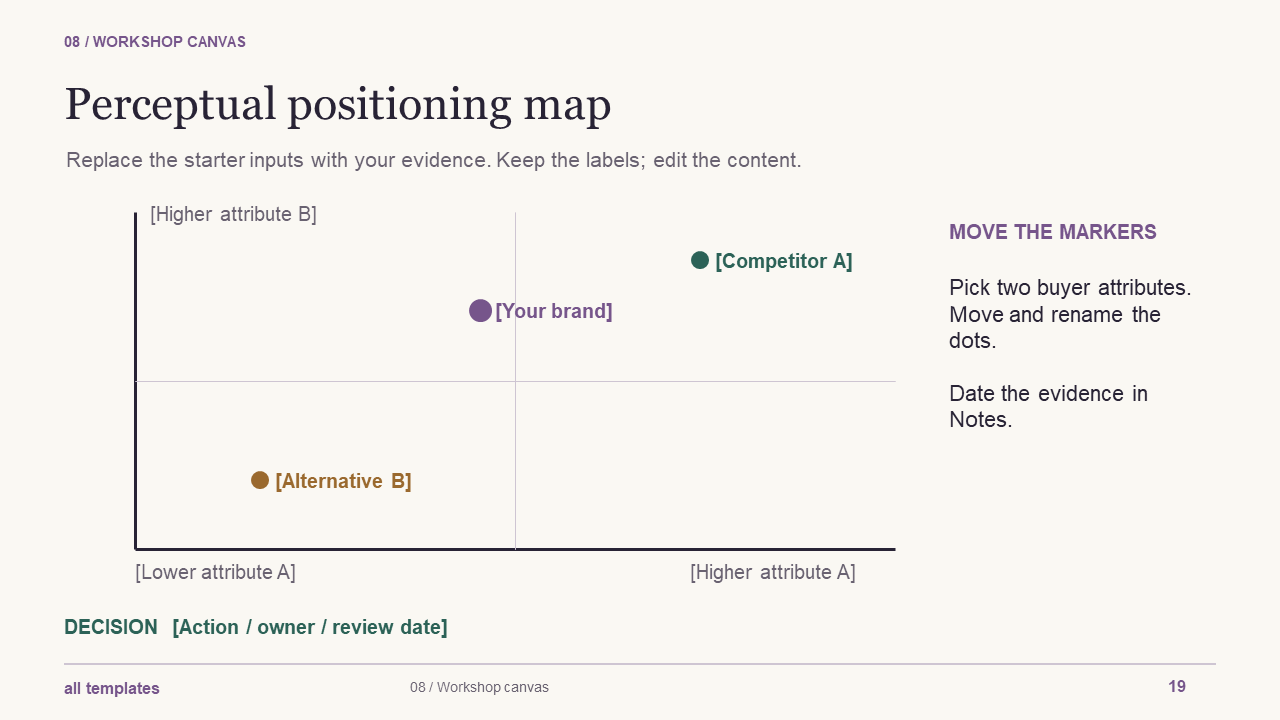
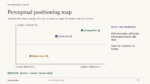
- Perceptual positioning map: compare brands using two customer-relevant attributes.
- Customer value proposition: balance functional and emotional benefits against money, time, effort and risk.
- Five product levels: core benefit, basic, expected, augmented and potential product.
- Marketing mix — 4Ps: align product, price, place and promotion.
- BCG growth–share matrix: assess stars, question marks, cash cows and pets/dogs.
- Ansoff growth matrix: explore penetration, market development, product development and diversification.
- Product life cycle: adapt decisions across introduction, growth, maturity and decline.
- G-STIC implementation and control: connect goal, strategy, tactics, implementation and control.
Free vs Pro
| Edition | What you get |
|---|---|
| Free | 17 slides: five frameworks — SWOT/TOWS, segmentation, targeting, positioning and 4Ps — with examples and workshop canvases, a strategy summary and a preview of the remaining models. |
| Pro — $4, one-time | 36 slides: all 15 frameworks, 15 worked examples, 15 editable workshop canvases, instructions, a one-page strategy summary and source references. |
How to use the template
- Save a copy for your company or client project.
- Read the worked example, then duplicate the corresponding workshop slide.
- Replace starter inputs with your research; edit tables and move map markers.
- Record a decision, owner and review date, then bring the choices into the one-page strategy.
Format and important details
Downloadable .pptx file, widescreen 16:9, designed and tested in Microsoft PowerPoint. Native editable text, shapes and tables; no macros. Examples and market figures are fictional. Ratings and financial examples are manual teaching inputs, not automatically calculated dashboards.
A curated selection of strategic marketing concepts taught in marketing management, including Kotler-related concepts and models by Porter, Ansoff, BCG and other contributors. Original All Templates layouts and examples; source references are included. This is not an official Kotler publication or an exhaustive list of every marketing framework.
Use and edit for your own work or business. Redistribution or resale of the template files is prohibited.
Practical guide
How to choose marketing frameworks and turn them into a strategy — a step-by-step guide with model selection, evidence checks and workshop tips.
Try it with a worked example
Choose between two possible segments with the same criteria: reachable demand, expected contribution and cost to acquire a customer. Put one piece of evidence beside each score and flag the assumption most likely to reverse your choice.
All you need to know about marketing strategy frameworks
Name the decision. Write the decision and who will use it before choosing a diagram.
Build the foundation
- Name the decision. Write the decision and who will use it before choosing a diagram.
- Use SWOT to organize evidence. Capture internal strengths and weaknesses and external opportunities and threats.
- Translate SWOT into actions. Link each proposed move to evidence and specify an owner.
- Use Five Forces for the industry. Assess the pressures that shape margins across an industry.
- Map customer perceptions. Choose axes buyers actually use and show where offers sit based on their evidence.
Put it into practice
- Use Ansoff to assess growth direction. Distinguish existing and new products and markets before comparing risks.
- Use a customer journey for handoffs. Map behavior when the decision concerns experience and conversion.
- Treat scores as assumptions. Explain weights and sources and test whether small changes reverse a recommendation.
- Combine methods where they answer different questions. Use the industry lens for outside pressures and the buyer lens for selection criteria.
- Close with a decision and a test. Record what you will do, what you will measure and what would change the direction.
Frequently asked questions
What is a marketing framework?
It is a structured way to examine evidence for a marketing decision.
When should I use SWOT?
Use it when you need an overview of internal capabilities and external conditions.
When is Five Forces a better fit?
Use it to study industry structure and pressure on profitability.
How do I choose perceptual map axes?
Choose distinct attributes buyers use and gather comparable evidence for each.
What are the four Ansoff growth options?
Market penetration, market development, product development and diversification.
Can I combine multiple frameworks?
Yes when each answers a distinct question that changes the decision.
How can a workshop avoid guesswork?
Bring evidence, label unknowns and assign verification work before finalizing priorities.
Does a blank gap on a positioning map prove demand?
No. Check whether customers value the combination and whether you can deliver it.
When should I refresh a framework?
Refresh when market conditions, buyer behavior or the decision changes materially.
What should the final strategy slide contain?
State the recommendation, supporting evidence, main risk and next test.
Devon Blake –
The slides look workshop-ready. I’d like a closer look at one of the completed frameworks.
Nadia Farouk –
SWOT and Ansoff in the same PowerPoint is handy. Looks good for a quick workshop.
Owen Atkinson –
The PowerPoint format is what did it for me. I can see opening the deck before a workshop, picking the two frameworks we actually need, and having something for the group to react to. SWOT and Ansoff are familiar enough to get people talking pretty quickly, and it’s nice seeing them together in one preview.
Jordan McLeod –
Handy to have the frameworks in one deck. I was mainly looking for something I could use to kick off a workshop.