
Marketing Audit Best Practices: Turn Checks into a 90-Day Plan

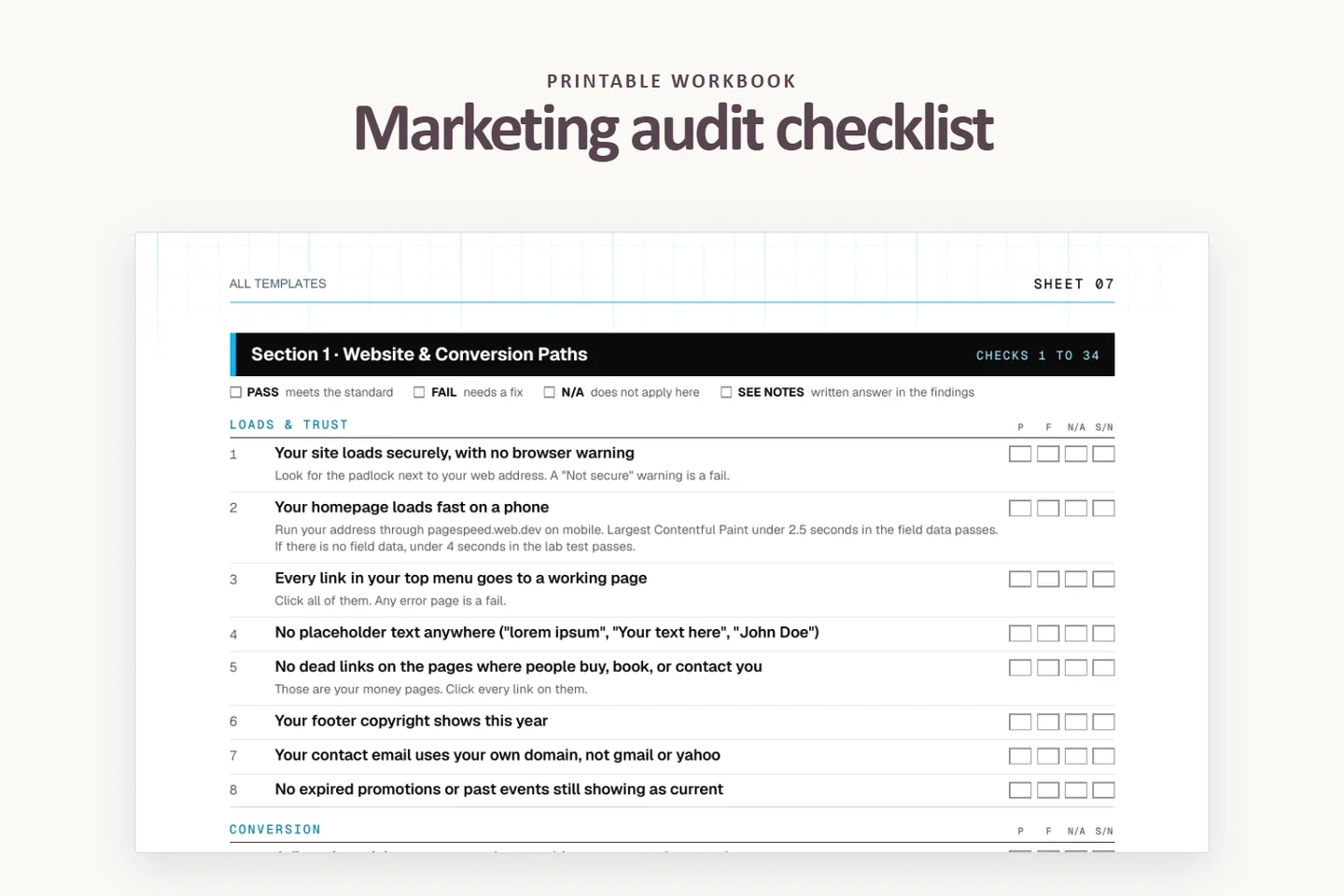
A useful marketing audit ends with decisions: what to repair, what to test and what to stop doing. A long list of observations is only the starting point. This guide shows how a small team can turn a review of its digital presence into a practical 90-day plan.
Use the Marketing Audit & Business Brief PDF template alongside the process. The free version covers 34 website checks; the $3 Pro workbook includes 160 core checks, a scorecard, planning worksheets and clickable checklist statuses.
Start with a business question
Before opening a dashboard, write down the decision the audit needs to support. For a local service business, that might be why website inquiries are not becoming booked appointments. For a small online store, it might be which product pages deserve attention before the next promotion.
Define the audience, offer, time period and desired customer action in a short brief. Agree on what counts as a qualified inquiry or completed order. Then identify the person who can explain each data source. This keeps a website review from quietly becoming an unlimited investigation.
HubSpot’s introduction to marketing audits provides useful context on systematic reviews and choosing an audit scope. The workflow below applies that broad principle to a practical workbook and a small team’s implementation capacity.
Collect evidence before selecting a status
For every checklist item, record what you actually observed. Open the destination behind a button, test a form with clearly labeled test data, or review a dated report. Avoid marking an item as passed because someone remembers fixing it months ago.
| Area | Evidence to collect | Useful question |
|---|---|---|
| Website and conversion | Mobile screenshots, tested links and form delivery | Can a new visitor complete the intended action? |
| Local presence | Profile details, opening hours and destination links | Does the listing describe the business accurately? |
| Content and social | Recent posts, landing pages and relevant outcomes | Is each piece helping a defined audience take a next step? |
| Measurement | Event definitions, source reports and date ranges | Are we comparing the same thing across reports? |
| Ownership | Named owners and verified account access | Can the responsible person make and maintain the change? |
Use N/A for a check that genuinely does not apply. Use Notes when a result needs explanation or remains uncertain. A missing measurement is a finding to investigate; it is not proof that the channel is failing. Keep the evidence date with the finding so that the next reviewer can reproduce it.
Review the customer journey on a phone
Follow one realistic route from discovery to inquiry or purchase. Start from a search result, social bio or campaign link. Check whether the destination matches the promise, whether the next action is clear, and whether the confirmation tells the customer what happens next.
Separate technical measurements from your own impression. Google’s Largest Contentful Paint guidance defines good LCP as 2.5 seconds or less at the 75th percentile. A single lab run can help diagnose a problem, but it does not describe every real visitor’s experience. Keep device, connection and measurement method with the result.
For eligible local businesses, check factual profile details too. Google recommends complete, accurate information and explains that local results depend mainly on relevance, distance and prominence. See its local ranking guidance. Improving a profile is worthwhile, but a checklist score cannot guarantee rankings.
Use the scorecard to organize discussion
A section score makes gaps easier to see, especially when several people contribute to an audit. Keep the underlying findings visible: a small number of failures in an important customer path may matter more than many minor presentation issues elsewhere.
Agree how you will handle non-applicable checks before comparing audits. Do not treat a higher checklist total as evidence of higher revenue. The score describes the checks you performed; business outcomes need their own measures and observation period.
Choose fixes by consequence and effort
For each finding, write the affected customer action, the evidence, an owner and a definition of done. Start with issues that block a customer or prevent reliable measurement. Then schedule improvements that need design, content or development work.
| Example finding | Priority and owner | Definition of done |
|---|---|---|
| Inquiry form submissions do not reach the team | Immediate; website owner | A labeled test arrives and the confirmation is verified |
| Social bio links to an expired offer | This week; content owner | The link opens a current, relevant page on mobile |
| Service pages leave common questions unanswered | This month; marketer and service lead | Updated copy answers agreed customer questions |
| Reports use different lead definitions | Before budget decisions; analytics owner | A documented definition and comparable report are available |
These are illustrative examples, not results from a client audit. The right ordering depends on your business. Avoid assigning every issue the highest priority: a plan that exceeds the team’s capacity will leave even important fixes unfinished.
Turn findings into a 90-day review cycle
Use the first month to repair the most consequential gaps and establish trustworthy measurements. In the second month, run a small number of focused tests with a clear hypothesis. In the third, review the results and decide which changes to keep, revise or discontinue.
Schedule short progress reviews rather than waiting until day 90 to discover a blocker. Record both implementation and outcome: a repaired link can be verified immediately, while a conversion change needs enough comparable observations. Note promotions, seasonality and other changes that could affect the result.
Run your next audit with the workbook
The Marketing Audit & Business Brief template brings the checklist, scorecard, priorities, content planning and ownership review into one PDF. Download the free sample or choose the complete 24-page Pro version for $3.
Open the PDF in a reader that supports forms, select one status per checklist row and save a copy. Written worksheets and scoring are manual; use PDF annotations or print them. For a deeper external comparison, pair the audit with our competitor analysis guide.