
How to Run a Weekly Cash Review and Monthly Finance Close


A business can finish a profitable month and still miss Friday’s payroll. The invoice that made the sale profitable and the deposit that funds payroll can land weeks apart. A weekly cash meeting and a monthly close answer those two questions on different clocks. Here is a practical way to run both, with a worked example you can check on paper.
Take a cash snapshot before moving any forecast dates
Pick a cut-off time, record cleared balances for each operating account and note cash that is restricted or unavailable. Match transfers between your accounts before summing them. A transfer in transit can otherwise appear as both yesterday’s closing cash and today’s receipt. Write down the date of the last reconciliation so a colleague can reproduce the starting balance.
Keep the forecast you used last Friday. Compare it with this week’s bank activity before rolling the schedule forward. Mark every material difference as timing, amount or a missing transaction. If an invoice moved two weeks, move the receipt to the expected week and retain the original promise date in your follow-up notes.
Work in weeks for payments and collections
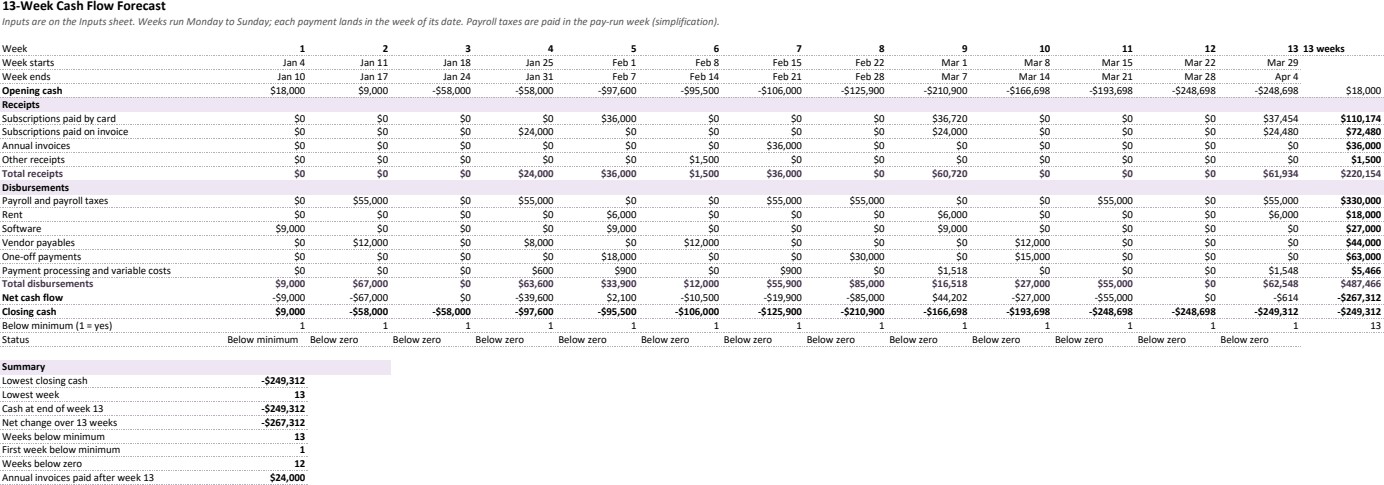
Start with the next payroll, rent and committed supplier runs. Add expected customer receipts against the invoice reference. For a disputed invoice, record the amount in dispute and a separate expected date for the agreed portion. Give each uncertain receipt an owner who can verify the date before the next review.
| Week ending | Opening cash | Receipts | Payments | Closing cash |
|---|---|---|---|---|
| 8 January | 18,000 | 4,200 | 5,100 | 17,100 |
| 15 January | 17,100 | 6,900 | 3,000 | 21,000 |
| 22 January | 21,000 | 2,400 | 4,600 | 18,800 |
Suppose 4,000 of the second week’s receipts arrives one week late. The revised closing balances are 17,100, 17,000 and 18,800. The three-week ending balance stays the same, but the middle week loses 4,000 of headroom. If the team’s operating floor is 18,000, someone must own the decision for both weeks below that floor.
Work the two sides of cash separately
In collections, rank invoices by open amount, due date and likelihood of payment. A customer who paid 800 against a 2,200 invoice owes 1,400. Contact the customer about that balance, and forecast cash against the agreed payment date. On the payables side, confirm that credits, part payments and existing payment instructions have been applied before authorising a run.
Use the receivables ageing workbook and supplier payment calendar to identify the documents that explain the cash forecast. For new billing, check the currency, unit price, agreed discount and remittance details on the printable invoice before sending it.
Close the month with evidence
Match bank entries by reference, amount and date. A bank fee missing from the ledger needs an entry. An outstanding cheque that already appears in the ledger needs tracking until it clears. Treating both as new expenses would double-count the cheque. Carry open reconciling items forward with a date and owner, then verify each against the next statement.
Explain a variance before revising the budget
Keep the approved budget fixed. If Sales spent 1,400 on travel against a budget of 1,200, the expense variance is 200 over budget. Check whether it was an extra trip, a higher fare or a bill booked in a different period. Only the first two necessarily change the expected full-year cost. Record the driver, proposed response and effect on the latest forecast.
For payroll, separate the cost of a new hire from partial-month timing and employer charges. A full-time role with a 60,000 annual salary and a 20% employer load costs 6,000 for a full month under those assumptions. A later start changes the first month and leaves the annual salary rate intact. The headcount plan and department variance workbook let the team investigate those decisions separately.
Check the economics of the proposed response
A lower selling price can increase sales volume and still leave the business short of its fixed costs. With a price of 50, variable cost of 30 and fixed costs of 4,000, the break-even volume is 200 units. Cut the price to 46 without changing costs and the business needs 250 units. Confirm that sales and production can deliver those extra 50 units before approving the discount.
What to put in a one-page cash review
Send the same snapshot before every meeting. Put the review date, cleared cash at that time, the lowest forecast balance and its week, the operating floor and the amount below that floor at the top. Underneath, name the receipts and payments that could change that result. If a receipt needs confirmation, record the last promise, the evidence you have and the person who will get an answer. When next week’s reviewer opens the file, they should be able to explain a change without reconstructing it from email.
| Signal | Amount | Action and owner |
|---|---|---|
| Week 1 closes below floor | $900 short | Controller confirms the opening balance and the exact payroll debit date before Tuesday. |
| Customer receipt shifts from week 2 to week 3 | $4,000 moves, leaving week 2 $1,000 below floor | Account owner gets a written payment date and confirms the amount scheduled. |
| Week 3 closes above floor | $800 headroom | Finance lead revisits optional spending once the receipt clears. |
Stress-test changes that change an actual decision
Start with your best supported case. Copy it and move the largest uncertain customer receipt by a week, then record the lowest weekly balance in both versions. On a second pass, bring forward any unavoidable payment you think could clear early. Label exactly what you changed. A case that changes several assumptions at once is useful for escalation, but a one-change case explains which call or approval has the greatest value.
Look inside a high-risk week when payroll and receipts fall on different days. A Friday closing balance can recover from a shortage on Wednesday. Sketch the daily running balances for that week, put fixed payment dates in first and ask who can make a decision before the first short day. Record any agreed new supplier date alongside the original due date so an updated forecast does not hide an overdue obligation.
Turn the month-end close into a repeatable checklist
- Collect the evidence. Save the period’s bank statements, payout reports and invoice and bill registers. Use a naming convention that includes the account and month.
- Check cutoff and reconcile. Investigate fees and missing entries, explain timing differences and track open items until they clear. Separate credit card purchases from the transfer used to pay the card.
- Review open balances. Check that part payments and credits have been applied. Ask the person responsible for each old, disputed or unusually large balance to explain the next action.
- Review the figures. Compare actuals with the approved budget and compare assumptions with the latest forecast. Record evidence, owner and date for corrections or provisional figures.
- Save the handoff. Keep a dated close snapshot and a short list of follow-ups. Use the closing cash and updated payment dates as evidence for the next forecast.
Questions before you run the first review
Should you count an open invoice in weekly cash?
Include the collectible amount in the week you reasonably expect it to clear. Base the date on a payment commitment or observed behavior. Use a later date in your downside scenario if the timing is uncertain.
Which number should go to management?
Show cleared cash as of the review date, the lowest forecast closing cash and when it occurs, then the amount by which it might miss your floor. Add the first decision the team can make that changes that outcome.
For recordkeeping and the distinction between statement adjustments and ledger corrections, see the IRS guide to small-business records and reconciliation.
Set a close calendar that fits the way the business operates
Give the close its own calendar. For example, on the first business day collect statements and lock the reporting cutoff. On the second, finish the bank and processor reconciliations. On the third, compare invoice and supplier registers with the ledger. On the fourth, have a second person review exceptions, material changes and the supporting documents. Set handoffs by owner and record which numbers are provisional if a statement or bill arrives late. A missed deadline should have a revised date and a named owner so it does not quietly move into next month.
Keep two lists after the meeting. The first records adjustments already posted, with the supporting document and reference. The second records open exceptions and the evidence still needed. Start the next close by checking the second list against what cleared or was corrected. If a recurring exception still has no owner, give it one before adding a new report.
Leave the meeting with three decisions
- Which cash receipt or payment needs action before the next payroll? Record the owner and deadline.
- Which variance changes the forecast for the rest of the year? Preserve the approved budget and document the revised assumption.
- Which balance is still provisional? Record what evidence will resolve it and when the team will check again.
Start with the 13-week forecast, bank reconciliation or break-even model. The Finance Starter Kit includes the complete set of 15 PRO workbooks. Its source library points to primary data for testing assumptions, including FRED for historical rates and the Employment Cost Index for compensation trends.
Choose the next finance workflow to improve
Open the guide for the step you need to improve. Each includes a worked example and a link to the matching workbook.
- Build a 13-week cash flow forecast
- Make and check an Excel invoice
- Build an accounts receivable aging report
- Schedule accounts payable and review a payment run
- Reconcile the bank statement and the ledger
- Calculate break-even and test a new price
- Plan headcount, FTE and the payroll budget
- Explain budget versus actual spending
Taking the cash snapshot before changing forecast dates is a good reminder. The weekly review and the month-end close often get lumped together, so I appreciated seeing which question each meeting is meant to answer.