




Description
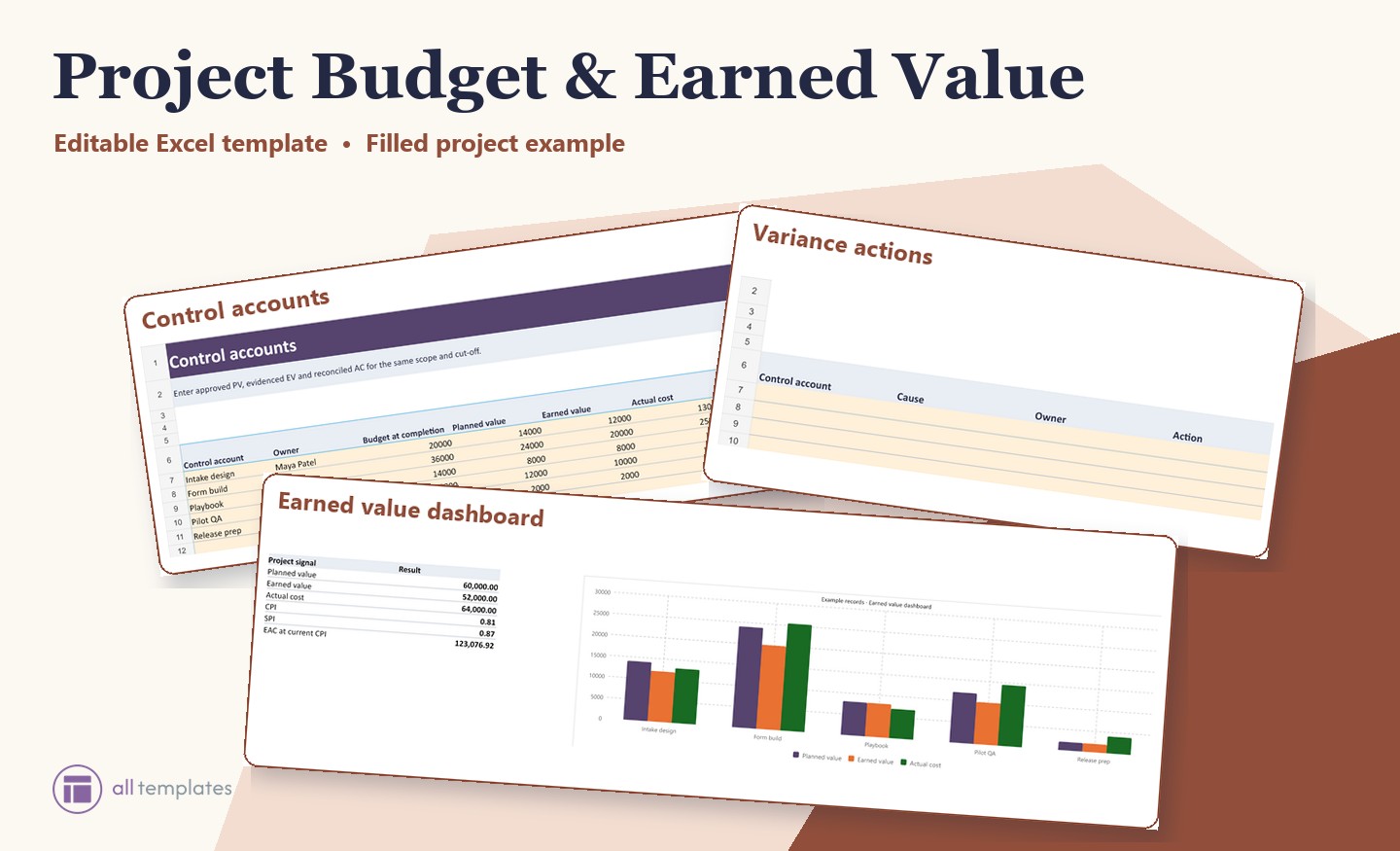
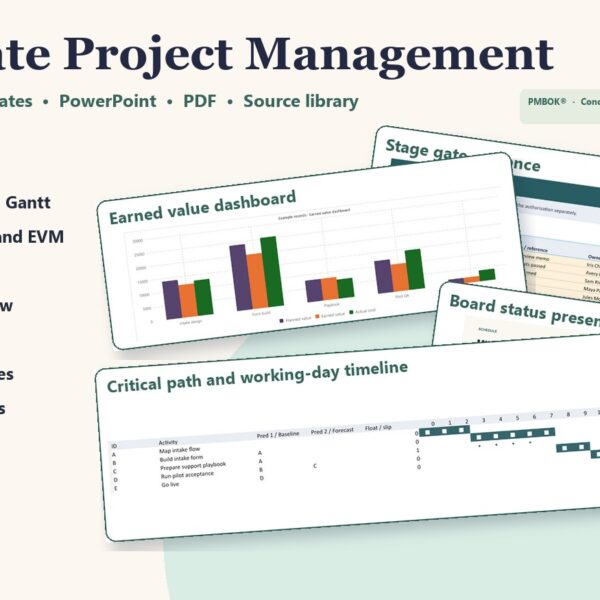
Read schedule and cost performance in the same review. Bring planned value, earned value and reconciled actual cost together at a single status date, then decide which control account requires action.
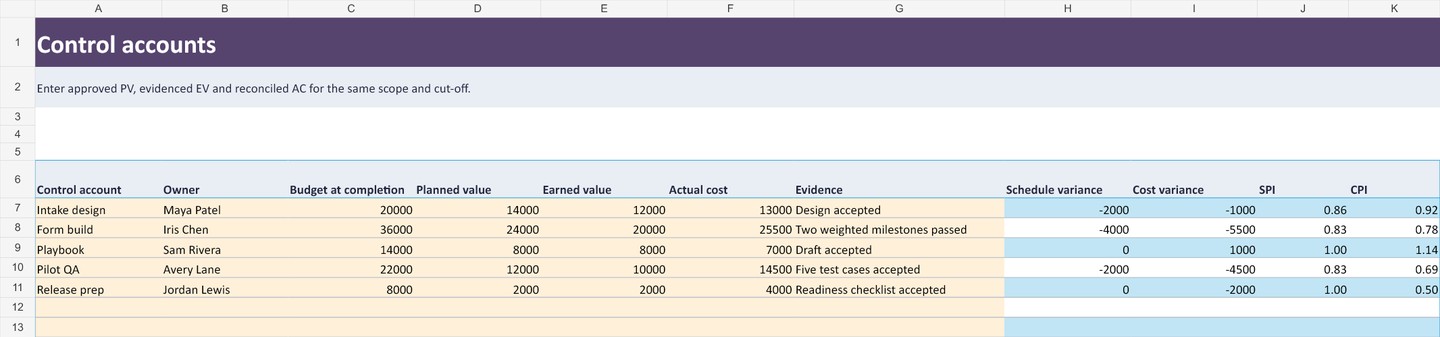
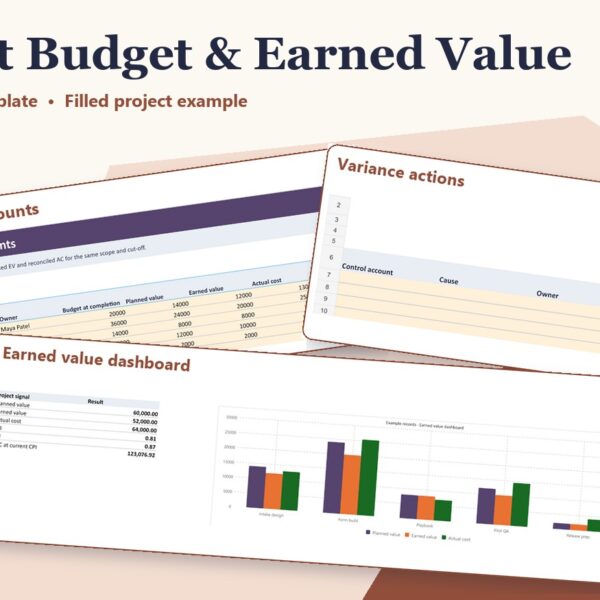
- Enter budget at completion, planned value, earned value and actual cost by control account.
- Calculate schedule and cost variances and performance indices.
- Read project-level figures and compare the example control accounts on the dashboard.
- Document each variance cause, action, owner and due date.
Includes one editable Excel workbook (.xlsx) with a filled fictional example and a built-in guide. This is a status-date workbook. Supply cumulative inputs from your baseline, completion evidence and accounting records. Keep dated copies if you need a historical series.
Compare Free and Pro
| Feature | Free manual starter | Pro Excel workbook |
|---|---|---|
| Example data | Five sample records on one sheet | The example plus prepared working rows and supporting sheets |
| Calculations | Enter and review numbers manually | Schedule variance, Cost variance, SPI, CPI |
| Review and follow-up | Use the starter table as a reference | Earned value dashboard and Variance actions |
| Instructions | Short notes inside the starter | Dedicated How to use sheet |
Download the free manual starter
How to use
- Agree the status date and the control-account scope before collecting numbers.
- Enter approved planned value, earned value backed by completion evidence, and actual cost reconciled at the same cut-off.
- Review the overall indices and investigate the control accounts behind the variance.
- Record the corrective action, owner and follow-up date on Variance actions.
Use cases
- A PMO preparing a budget and performance review.
- A finance partner distinguishing an overspend from an apparent underrun caused by delayed work.
- A control account owner explaining a variance with weighted milestones or acceptance evidence.
Related Products
All you need to know about project budgets and earned value
- Record the cutoff visibly
Include the baseline version, cutoff date and source data timestamp beside the report. When updating it, reconcile whether schedule progress and posted costs cover exactly the same reporting period.
- Check the accounting window
Identify significant invoices and accrued costs that arrived across the boundary. Ask Finance which treatment applies before using the data to assess a team’s performance.
- Use the approved progress rule
Define the rule at planning time and collect evidence consistently. Changing how a milestone earns value after observing the results weakens any period comparison.
- Calculate ratios from summed numerators and denominators
Combine PV, EV and AC first. Dividing project totals gives an appropriately weighted measure. Averaging the control accounts’ ratios would give a small work package the same influence as a large one.
- Investigate the denominator
An undefined index and a zero result have different meanings. When PV or AC is zero, check whether the baseline has started or whether the cost feed is complete.
- Use the network for date consequences
A negative schedule variance shows that planned budgeted work has not been achieved. Compare the current schedule model and critical dependencies to determine whether the completion date is threatened.
- Look at both current and cumulative performance
A good current period can coexist with a poor cumulative record. Review recent trends and analyze any large period change before attributing it to a sustained recovery.
- Keep one cause per action where practical
After investigating the variance, record the confirmed cause, proposed change, owner and due date. Define what observable movement you expect from the intervention.
- State the forecast assumption
If using a performance index to project costs, explain why past performance is expected to persist. Compare it with a bottom-up estimate and reconcile material differences before asking for more funding.
- Use change control to revise authorized plans
Document approved baseline revisions, preserve the former version and explain the rationale. This keeps the performance history interpretable.
Worked example
At the agreed cutoff, which control account should Harbor investigate first, and what does the project total say?
| Control account | BAC | PV | EV | AC | CV |
|---|---|---|---|---|---|
| Intake design | $20,000 | $14,000 | $12,000 | $13,000 | −$1,000 |
| Form build | $36,000 | $24,000 | $20,000 | $25,500 | −$5,500 |
| Playbook | $14,000 | $8,000 | $8,000 | $7,000 | $1,000 |
| Pilot QA | $22,000 | $12,000 | $10,000 | $14,500 | −$4,500 |
| Release prep | $8,000 | $2,000 | $2,000 | $4,000 | −$2,000 |
| Total | $100,000 | $60,000 | $52,000 | $64,000 | −$12,000 |
PV is $60,000, EV is $52,000 and AC is $64,000. Schedule variance is −$8,000 and cost variance is −$12,000. SPI is 0.87 and CPI is 0.81 when rounded to two decimals. The team has earned about 81 cents of budgeted value per dollar spent. It should review form build first for cost variance, since that account has the largest shortfall. It should also check whether the form is driving the current delivery forecast.
If past cost efficiency were expected to persist, dividing BAC by the unrounded CPI would give an illustrative estimate at completion of about $123,077. That assumption is a choice, so check it against the expected cost of the remaining work. When the shortfall is explained by a one-off event, build a bottom-up estimate to complete and document why it is more informative.
Frequently asked questions
Why can costs look under budget when performance is poor?
If work is incomplete, spending may also lag. Compare actual cost with the value actually earned, and check earned value against the baseline planned value. These comparisons answer different questions from budget to actual spend.
Can teams earn value from hours worked?
The accepted measurement rule determines when value is earned. Where a measurable deliverable exists, use objective quantities or weighted milestones. Hours alone can rise without a corresponding change in delivered work.
Why is schedule variance expressed in currency?
PV and EV use budget basis, so their difference is in budget units. Use dependency analysis and finish forecasts to describe time. Some organizations use other earned schedule metrics alongside the baseline schedule.
What does CPI below one mean?
On the reported scope and cutoff, actual cost exceeds the budgeted value earned. Check evidence and cost mappings first, then determine whether an operational problem or a reporting difference caused the gap.
Can I use earned value on a small pilot?
Yes. Choose a light control-account structure and objective milestones proportionate to the decision. Use only as much reporting detail as needed to understand significant cost, schedule or acceptance risk.
How does approved scope change affect the baseline?
Apply the authorized change through the project’s baseline process. Retain the prior approved model and document changes to scope, time-phased budgets, dates and control account responsibilities.
What if parts of the project have different currencies?
Use an agreed conversion basis so the figures can be combined consistently. If exchange effects are material, explain them separately. Keep source values and transaction dates available for reconciliation.
What is estimate to complete?
ETC is forecast spending for the remaining work. Adding ETC to actual cost gives estimate at completion. Use current scope, remaining quantities, rates and known risks to support a bottom-up calculation.
What if total cost variance is close to zero?
Check individual accounts because positive and negative differences can offset. Investigate material contributors and review whether the performance trend or completion forecast still needs action.
When should I close an action?
Agree what evidence will show the cause was addressed. Check the resulting work, cost or forecast and record the new observation at the next cutoff. Keep the action visible until its defined outcome is verified.
Further reading
- Use PMI’s standard for terminology and measurement principles. PMI Standard for Earned Value Management.
- Consult the GAO guide for cost, baseline and earned value assessment practices. GAO Cost Estimating and Assessment Guide.
- Use the schedule guide to investigate actual time impacts. GAO Schedule Assessment Guide.
.

Reviews
Clear filtersThere are no reviews yet.