


Description
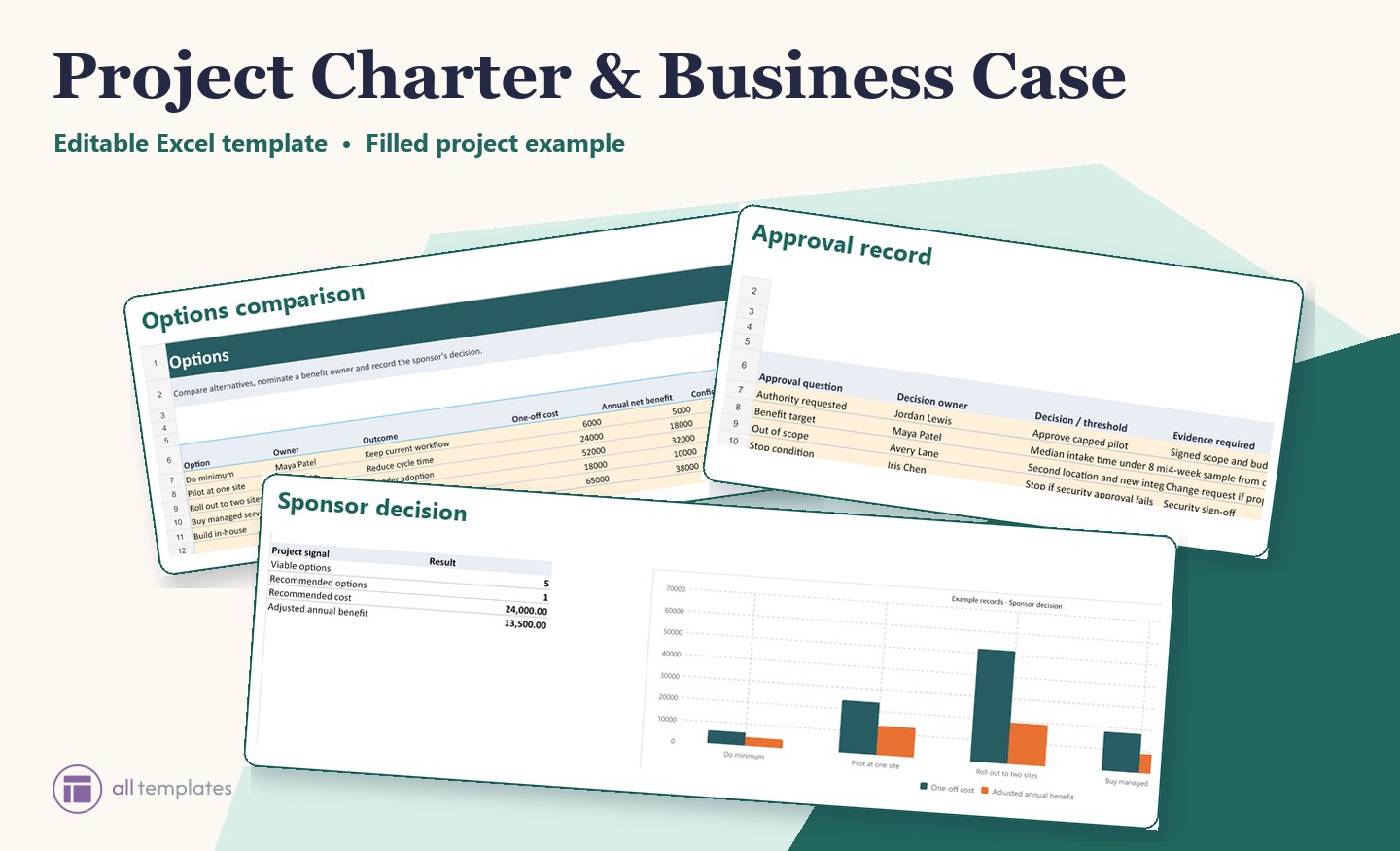
Give the sponsor a clear decision to make before the team commits budget and delivery capacity. Compare options using the same benefit period, then record what the sponsor is authorizing, the constraints that apply and the evidence that will trigger a review.
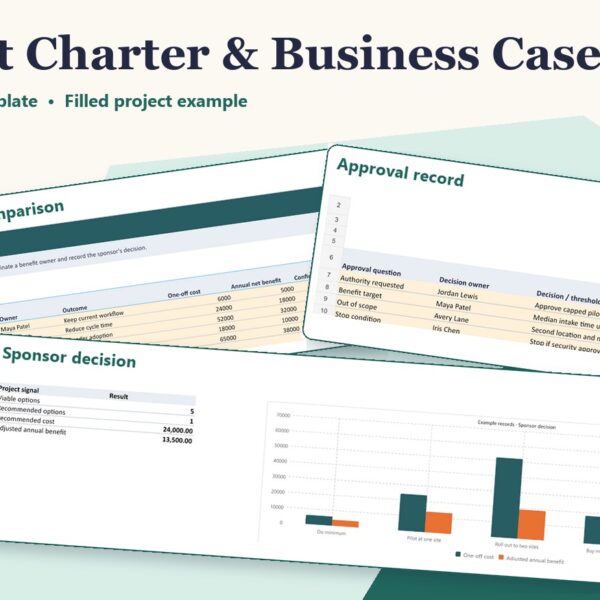
- Compare options on one-off cost, annual net benefit and confidence.
- Calculate confidence-adjusted annual benefit and simple payback.
- Record approval authority, benefit targets, exclusions, stop conditions and decision review evidence.
Includes one editable Excel workbook (.xlsx) with a filled fictional example and a built-in guide. Payback uses a simplified steady-state calculation. Use a separate cash-flow model for discounting, ramp-up or uneven annual benefits.
Compare Free and Pro
| Feature | Free manual starter | Pro Excel workbook |
|---|---|---|
| Example data | Five sample records on one sheet | The example plus prepared working rows and supporting sheets |
| Calculations | Enter and review numbers manually | Adjusted annual benefit, Risk-adjusted payback (years) |
| Review and follow-up | Use the starter table as a reference | Sponsor decision and Approval record |
| Instructions | Short notes inside the starter | Dedicated How to use sheet |
Download the free manual starter
How to use
- Open How to use, then review the five Harbor Intake Pilot alternatives.
- Replace the option names, owners, costs and expected annual net benefits in Options. Enter a confidence estimate backed by evidence.
- Review the adjusted benefit and payback alongside the outcome and implementation risks.
- Fill in Approval record and bring the specific authorization requested to the sponsor.
Use cases
- A sponsor deciding whether to fund a one-site pilot before approving a rollout.
- An operations lead comparing a managed service with an in-house build.
- A project manager turning an informal request into a documented funding decision.
Related Products
All you need to know about project charters and business cases
- Capture the observed baseline
Include the volume, period and data owner beside the current performance figure. If a smaller sample is all that exists, authorize an early measurement task and mark the larger commitment conditional.
- Retain the smallest credible option
Record what keeping or lightly improving the current approach would cost, including ongoing workarounds. This prevents the case for action from depending on a weak comparison with a costless status quo.
- Compare steady-state benefit consistently
Use the same baseline and units for each option. Where one model assumes a three-month ramp, place that assumption alongside the number rather than representing it as immediate operating savings.
- Separate accounting savings from freed capacity
Specify who can redeploy the saved hours and where they will go. Where no reduction in spending is expected, state the capacity benefit in hours in addition to any monetary proxy.
- Assign an owner to every material benefit
Choose someone with access to operational evidence after the project closes. Ask that person to confirm both the baseline figure and the measurement date before the sponsor authorizes work.
- Show the weakest assumption
Identify the input most likely to reverse the choice. Run a conservative value and report which option wins under it. Ask for evidence before firming up a large commitment.
- Make exclusions concrete
Define the location, interfaces or workgroups outside the authorization. Use change control when a team requests one of those items because it will affect the investment comparison.
- Set a bounded authority envelope
Put a funding ceiling, sponsor, time limit and decision rights in the charter. The project lead should be able to distinguish routine delivery choices from changes that need authorization.
- Preserve proof of approval
Record the authority, date, charter version and the decision conditions. Link to the approved case so everyone can trace why the sponsor accepted one option over another.
- Revisit the case at a decision point
Choose a review date tied to new evidence or a funding decision. If expected benefits fall or constraints change, update the business case and seek renewed authorization when warranted.
Worked example
Which option should Harbor approve if it wants credible evidence before committing to a broader rollout?
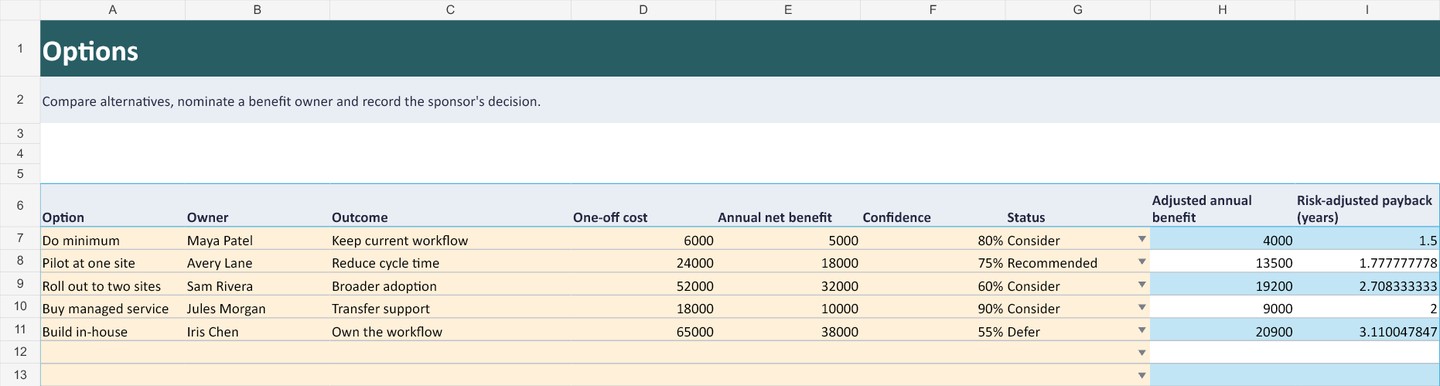
| Option | One-off cost | Annual net benefit | Confidence | Adjusted payback |
|---|---|---|---|---|
| Do minimum | $6,000 | $5,000 | 80% | 1.50 years |
| Pilot at one site | $24,000 | $18,000 | 75% | 1.78 years |
| Roll out to two sites | $52,000 | $32,000 | 60% | 2.71 years |
The do-minimum option has the shortest payback among these three, but the pilot addresses the organization’s need to test an eight-minute intake target before scaling. Approve the pilot only when the scope and funding cap are accepted and the operational owner commits to measuring the result. If the sponsor’s sole priority is the shortest payback, the same table supports choosing the do-minimum option.
Ask the sponsor how much uncertainty the project can tolerate. With a 50% confidence assumption, the pilot’s adjusted annual benefit is $9,000 and payback rises to about 2.67 years. Record a minimum evidence threshold for a larger commitment. Whether the pilot is worth this downside depends on the value of learning, cash constraints and the confidence you can gain through a controlled test.
Frequently asked questions
Can one workbook hold the business case and the charter?
Yes. Keep the comparison of options and the authority granted distinguishable. Approve the case and the charter at the appropriate levels, then record which version of each the sponsor relied on. This supports later decisions even when both records share one file.
When is the charter written?
Draft it while the preferred option is being evaluated. Record formal authorization once the sponsor can accept scope, resources and decision rights. If the sponsor funds discovery only, state the discovery scope and evidence required before further work.
Who signs off a project charter?
Use the person or governance body empowered to commit resources. On a multi-team project, list other contributors and the approvals they control. Document whether their agreement is needed now or is a condition for a future release.
How detailed should project scope be?
Describe the outcome, its boundaries, material exclusions and how acceptance will be judged. Leave detailed decomposition until planning when appropriate. For an interface, identify the systems and expected result rather than freezing a technical design before discovery.
Where do uncertain costs belong?
Record a base estimate and provide the likely sources of variation. Link contingency rules to authority. If a particular uncertainty could invalidate the preferred option, document an alternative or stop trigger in the case.
Do you always select the shortest payback?
Use payback for screening alongside feasibility, risk and strategic fit. A short-payback option can miss a critical service outcome. A long-payback proposal can still pass if a binding requirement or well-supported strategic benefit outweighs the delay.
What if benefits cannot be priced reliably?
Retain physical measures such as error rate, response time or compliance coverage and state the acceptance threshold. Describe how the sponsor will compare these measures with cost and uncertainty before approving the recommended approach.
How should the charter handle a strictly mandatory change?
Explain what makes the change mandatory, the required deadline and who determined applicability. Compare credible ways of meeting the obligation. The sponsor still needs cost, timing and operating impact to choose the best implementation.
When should the case be updated?
Review it at a stage boundary or when a significant assumption, cost, benefit or risk changes. Use the previous version to make the difference visible, and record who approved proceeding on the revised basis.
What belongs in the approval record?
Keep the decision, date, named authority, amount and scope approved, evidence relied on and outstanding conditions. Add a review date and a person responsible for preparing the next decision when funding is incremental.
Further reading
- Use PMI guidance to ground governance, stakeholder and value discussions. PMBOK® Guide.
- Use PeopleCert’s guidance for continued business justification and decision roles. PRINCE2 Corporate Framework.
.
Reviews
Clear filtersThere are no reviews yet.